
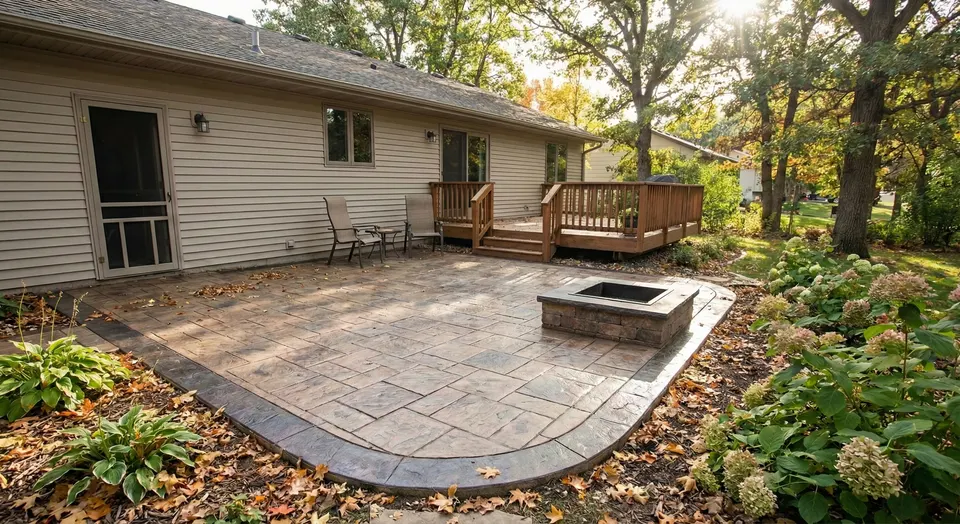
Patios, walks, pool decks, and borders
Backyard patios are the most common stamped job we do, from a 12 by 14 pad off a walkout door to a full outdoor living area with a fire pit ring, a step down, and a curved edge. Stamped front walks and entry landings give a house a finished look without the joints and weeds of pavers. Pool decks get a stamped texture with a slip-resistant additive in the sealer, laid out to shed water away from the pool and the house. Borders are a good way to get the look without stamping the whole slab: a broom-finished driveway or patio with an 18 to 24 inch stamped and colored band around the edge reads as custom and costs a fraction of a full stamped field.
Every one of those starts as flatwork. Topsoil off, Class 5 in and compacted, forms set to drain, reinforcement placed, and a 4 inch pour of air-entrained concrete. The pattern does not fix a bad base, and a stamped slab that heaves is a very expensive broken patio.
Patterns, color, and how the stamping happens
The patterns we stamp most are ashlar slate, random flagstone, cobblestone, running bond brick, and a few wood plank and texture-skin slate finishes. Color comes two ways. Integral color is mixed into the concrete at the plant, so the color goes all the way through and a chip does not show gray. A color hardener is broadcast onto the surface and worked in, which gives a harder, denser surface and richer color. A release agent in a second, darker tone is applied before stamping so the mats do not stick and the low spots pick up an accent color, which is what gives stamped concrete its depth.
The stamping itself happens in a window of an hour or two after the pour, when the concrete is firm enough to hold the texture but soft enough to take it. The mats are laid in sequence, tamped, and lifted, and the crew works across the slab from the edges in. Start too early and the pattern smears; start too late and the texture is shallow and the joints between mats show. On a big patio that means enough hands to place, color, and stamp before the concrete gets ahead of you. After the concrete cures, control joints are cut along pattern lines so they disappear into the design, and the surface is washed, dried, and sealed.
Sealing and living with stamped concrete in this climate
Sealer is what makes stamped concrete work in Minnesota. It locks in the color, keeps water and de-icing salt out of the surface, and gives the finish its sheen. It also wears. A stamped patio here needs to be cleaned and resealed every couple of years, sooner on a pool deck or a heavily used walk, or the color fades and the surface starts to scale where salt and freeze-thaw get in. That is a maintenance commitment, and we say so before you sign anything. We use a slip-resistant additive on pool decks and steps because a smooth glossy sealer on a wet stamped surface is slick.
The first winter matters most. No de-icing salt on new decorative concrete; use sand for traction. Shovel with a plastic-edged shovel rather than a steel blade that will scratch the sealer and chip texture. Keep the snowblower skids adjusted so the auger does not ride on the surface. A stamped patio treated that way will hold its look for a long time. One salted and scraped through its first winter will not.
What you get
- Full flatwork build under the pattern: compacted Class 5 base, reinforcement, air-entrained mix
- Ashlar slate, flagstone, cobblestone, brick, and plank patterns with integral color or color hardener
- Release agent accent color for depth, not flat single-tone surfaces
- Control joints cut along pattern lines so they read as part of the design
- Slip-resistant sealer on pool decks and steps
- Straight talk about resealing every couple of years before you commit
How the job goes
- 01
Walk the yard and pick the pattern
We measure, check grade and drainage away from the house, walk through pattern and color samples, and give you a written estimate that covers base, pour, stamping, and the first seal.
- 02
Strip and build the base
Sod and topsoil come out to firm subgrade, Class 5 goes in and gets compacted, and the base is graded so the finished slab sheds water away from the house and the pool.
- 03
Form, reinforce, and color
Forms are set to the layout including any curves and step-downs. Reinforcement is placed, and integral color is ordered at the plant or color hardener is staged for the pour.
- 04
Pour, stamp, cut, seal
The slab is placed and floated, color hardener and release are applied, and the pattern is stamped in the window. After cure we saw-cut joints on pattern lines, wash, and seal.
When we would talk you out of it
- A driveway that will be salted and plowed hard every winter. De-icing salt and steel plow blades eat sealer and chip texture. We would pour a broom-finished driveway and, if you want the look, add a stamped border.
- A homeowner who does not want to reseal. Stamped concrete that never gets resealed fades and scales in this climate. If that maintenance is a deal-breaker, a broom or exposed aggregate finish gives you a good-looking slab that asks nothing of you.
- A steeply sloped walk or a north-facing set of steps that ice up. Textured and sealed surfaces on a slope are slippery in winter. A broom finish with a stamped landing at the top and bottom gets the look where it is safe.
What stamped concrete costs in Wright County
Stamped concrete is priced by the square foot, and it costs more than the same slab with a broom finish because it takes more people on pour day, color and release materials, the stamping itself, and the sealing. The size of the slab sets the base number, but the pattern and color choices move it. One color with one pattern is the simplest. Two-tone color, a contrasting border, a pattern change between areas, and hand-detailed grout lines all add time.
Shape and site set the rest. Curved edges, step-downs, and a fire pit ring take more forming than a rectangle. A backyard the truck cannot reach means pumping or wheeling. Tearing out an old patio adds a day. And the first seal is included, but resealing every couple of years is a cost to plan for. What moves the price:
What moves the number
- Square footage and the shape of the slab
- Pattern and color complexity: single tone versus two-tone with borders
- Curves, step-downs, seat walls, and fire pit rings
- Base depth and drainage work the site needs
- Removal of an existing patio or walk
- Access for the ready-mix truck, or the need for a pump
- Slip-resistant additive and sealer type
Stamped & Decorative Concrete: questions we get asked
How long does stamped concrete last in Minnesota?
The slab lasts as long as any well-built concrete slab, meaning decades, when it sits on a compacted base with proper joints. The finish lasts as long as it is maintained. Resealed every couple of years and kept clear of de-icing salt, the color and texture hold up well. Never resealed, it fades and the surface starts to scale within a few winters.
Is stamped concrete slippery when wet?
It can be, especially with a high-gloss sealer on a smooth pattern. We mix a slip-resistant additive into the sealer on pool decks, steps, and walks, and we can use a matte sealer where traction matters more than sheen. Textured patterns like flagstone and slate have more grip than smooth ones. On slopes and shaded steps we recommend a broom finish instead.
How often does stamped concrete need to be sealed?
Every couple of years in this climate, sooner on a pool deck or a walk that gets a lot of traffic. The sealer is what protects the color and keeps water and salt out of the surface, and it wears down under sun, foot traffic, and winter. Cleaning and resealing is a small job compared to the patio, and skipping it is how stamped concrete fails here.
What patterns are available for stamped concrete?
Ashlar slate, random flagstone, cobblestone, running bond and herringbone brick, wood plank, and texture-skin slate are the ones we stamp most. Any of them pairs with integral color or a color hardener plus a darker release agent for depth. We bring samples to the estimate and can show you finished work nearby so you see the pattern at full scale before choosing.
Can you stamp a border on a regular driveway or patio?
Yes, and it is one of the best values in decorative concrete. A broom-finished field with an 18 to 24 inch stamped and colored band around the edge reads as a custom slab at a fraction of the cost of stamping the whole thing. The border gets the same color and sealer treatment, and the broom field handles salt and plows better than a fully stamped surface.
Related services
Where we do this work
Stamped & Decorative Concrete across Wright County from our shop in Cokato: Cokato, Dassel, Howard Lake, Annandale, Buffalo, Delano, and the townships between them. We also work east and north to Litchfield, Hutchinson, Monticello, St. Cloud, Maple Grove, Plymouth, and Minnetonka. See the full service area.