
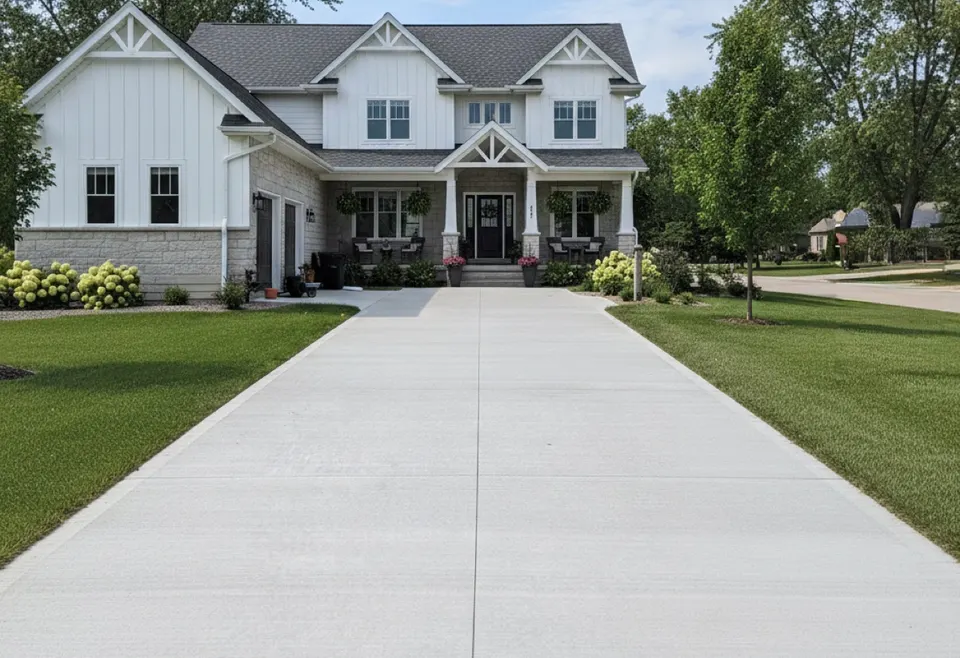
The base is the driveway
When a driveway cracks in its first winter, the concrete is almost never the problem. The base is. A slab poured on black dirt, on uncompacted fill, or on a couple of inches of whatever gravel was lying around moves every time the ground under it freezes and thaws, and the slab cracks to follow it. We strip the topsoil and any soft material down to firm subgrade, then bring in and compact a Class 5 aggregate base, typically 4 to 6 inches on a residential driveway and more where the subgrade is wet or soft. The base is graded so water runs away from the garage and off the slab, and it is compacted in lifts with a plate compactor or roller rather than driven over a few times and called good.
In the low ground around Cokato Lake and other wet sites in the county, base depth and drainage matter even more. A driveway that holds water at the garage door in October is a driveway with ice at the garage door in January and a heaved apron by March. We look at where the water goes before we look at anything else.
Thickness, reinforcement, and the mix
A standard residential driveway is 4 inches of concrete. That handles cars, pickups, and the occasional delivery truck when it sits on a proper base. We go to 5 or 6 inches where the driveway will see heavier loads: a camper or fifth-wheel pad, a farm driveway that sees grain trucks or a skid steer, the turnaround where the garbage truck backs up, or a light commercial entrance. Aprons where the driveway meets the garage floor and the street get the same or greater thickness because they take the most abuse from turning tires and plow blades.
Exterior concrete in Minnesota is an air-entrained mix, which gives the concrete millions of tiny air voids that give freezing water somewhere to go instead of breaking the surface. That is the difference between a driveway that scales and pits after a few winters of salt and one that does not. Reinforcement is a judgment call by driveway: wire mesh or rebar on grade for longer runs, aprons, and anything carrying heavy loads, fiber in the mix on smaller residential pours. Either way, the concrete gets placed at the right consistency, not watered down on site to make it easier to push around.
Control joints, finish, and cure
Concrete shrinks as it cures, and it will crack somewhere. Control joints tell it where. We saw-cut joints within a day of the pour, before the slab has a chance to crack on its own, and we lay them out on a grid that keeps panels close to square, roughly 10 feet apart on a 4 inch slab. Joints cut too late, too shallow, or too far apart are the other reason driveways crack in random patterns instead of along clean lines. Where the driveway meets the garage slab, the sidewalk, or the street, an isolation joint lets the two move independently.
The standard finish is a broom finish, which gives traction on ice and hides minor surface variation. Edges are tooled, and the apron at the street is set to the grade the city or county requires. After the finish, the slab cures under a curing compound or wet cover for several days. You can walk on it the next day, drive a car on it after about a week, and keep heavy trucks off it for a month. Skipping the cure to get the truck in early is how you get a dusty, weak surface.
Tear-outs, replacements, late-season pours, and permits
Replacing an old driveway starts with breaking out and hauling off the existing slab, then dealing with whatever base is under it. Often there is none, which explains the cracks. We rebuild the base rather than pour on the old subgrade, and we look hard at how the old apron met the garage floor, because a heaved apron pushing on the garage slab is a common reason people call. Partial replacements of a few panels are possible when the rest of the driveway is sound and the base is good, and we will tell you when that is a waste of money.
We pour driveways into late fall most years, sometimes into early December if the ground is not frozen and the forecast holds. Cold-weather pours mean an accelerator in the mix, concrete blankets on the slab for several days, and a longer wait before you drive on it. We do not pour on frozen ground and we do not skip the blankets. A new driveway connecting to a city street inside Cokato usually needs a permit from Cokato City Hall. On township roads it is Wright County Planning and Zoning in Buffalo, and if the driveway enters a county road, the access permit comes from the Wright County Highway Department. We will tell you which applies to your address.
What you get
- Topsoil stripped and a compacted Class 5 base graded to drain away from the garage
- 4 inches for cars, 5 to 6 inches for campers, farm traffic, and heavy aprons
- Air-entrained exterior mix that stands up to salt and freeze-thaw
- Control joints saw-cut within a day on a square grid
- Broom finish with tooled edges and a proper cure, not a rushed one
- Late-season pours done with accelerators and blankets, never on frozen ground
How the job goes
- 01
Walk the driveway and write the estimate
We measure, look at where the water goes, check the garage floor and street grades, ask what will park on it, and give you a written estimate with thickness, base depth, and any tear-out spelled out.
- 02
Strip, tear out, and build the base
Old concrete is broken out and hauled off. Topsoil and soft material come out to firm subgrade, and Class 5 goes in and gets compacted in lifts and graded to drain.
- 03
Form and reinforce
Forms are set to the finished grade with the slope built in. Mesh, rebar, or fiber is placed as the job calls for, and isolation joints go in against the garage slab and any walks.
- 04
Pour, finish, saw-cut, cure
The slab is placed, screeded, and broom finished with tooled edges. Joints are saw-cut within a day, the surface cures under compound or blankets, and we tell you when you can drive on it.
What a concrete driveway costs in Wright County
Driveways are priced by the square foot, and the size is the first driver, but two driveways of the same size can come in far apart. Tear-out is the biggest swing: breaking, loading, and hauling an old slab is a full day of machine and truck time before any new work starts. Thickness is next. A 6 inch camper pad or farm drive is half again the concrete of a 4 inch residential slab and usually carries steel. Base depth follows the soil; a wet site needs more Class 5 and more compaction than a well-drained one.
After that it is shape and access. A long rural driveway is more concrete per foot of forming than a short suburban one. Curves, a turnaround, or a wide apron add forming time. A pour the truck can back up to costs less to place than one that needs a pump or a lot of wheelbarrow work. Late-season pours add the accelerator and blanket time. What moves the price:
What moves the number
- Square footage and the shape of the driveway
- Tear-out and hauling of the existing slab
- Thickness: 4 inches for cars versus 5 to 6 inches for heavy loads
- Base depth and how much Class 5 the subgrade needs
- Reinforcement: fiber, mesh, or rebar
- Access for the ready-mix truck, or the need for a pump
- Cold-weather accelerators and blankets on late-season pours
Concrete Driveways: questions we get asked
How thick should a concrete driveway be in Minnesota?
Four inches is the standard for a residential driveway carrying cars and pickups, on a compacted Class 5 base. Go to 5 or 6 inches for a camper pad, a farm driveway that sees trucks or equipment, heavy aprons, or light commercial use. Thickness only works if the base under it is compacted and drains, which matters as much as the extra inches.
Is concrete or asphalt better for a driveway in Minnesota?
Asphalt costs less up front and softens in summer heat, needs sealing, and typically gets resurfaced sooner. Concrete costs more to install, lasts decades when poured on a good base with proper joints, and handles heavy vehicles and plow blades better. For a driveway you plan to keep for a long time in this climate, concrete is the better long-term surface.
When is the best time to pour a concrete driveway in Minnesota?
Late spring through early fall gives the easiest curing conditions. We pour into late fall most years, and into early December when the ground is not frozen and the forecast cooperates, using an accelerator in the mix and concrete blankets on the slab. What we will not do is pour on frozen ground. Booking early in the season gets you the best scheduling.
Why did my driveway crack after one winter?
Nine times out of ten it is the base. A slab poured on topsoil, uncompacted fill, or too little gravel moves with every freeze and thaw and cracks to follow the ground. The other common cause is control joints that were cut too late, too shallow, or too far apart, which forces random cracking. Both are prevented by a compacted Class 5 base and saw-cut joints within a day.
Do I need a permit for a new driveway in Cokato?
Usually, yes, if the driveway connects to a city street. Inside city limits that permit comes from Cokato City Hall. On township parcels, Wright County Planning and Zoning in Buffalo handles it, and if the driveway enters a county road you also need an access permit from the Wright County Highway Department. We will tell you which office applies once we have the address.
Related services
Where we do this work
Concrete Driveways across Wright County from our shop in Cokato: Cokato, Dassel, Howard Lake, Annandale, Buffalo, Delano, and the townships between them. We also work east and north to Litchfield, Hutchinson, Monticello, St. Cloud, Maple Grove, Plymouth, and Minnetonka. See the full service area.