
MCM Concrete · September 8, 2026 · Concrete Driveways
What a Concrete Driveway Costs in Central Minnesota
In short: A concrete driveway in central Minnesota is priced by square footage, tear-out, how much base the soil needs, slab thickness, reinforcement, finish, site access, and the time of year. Two driveways of the same size can land far apart because of what is under them and how far the truck has to travel. Twin Cities cost pages assume a short city driveway on existing base, which is not what most lots around Cokato look like.
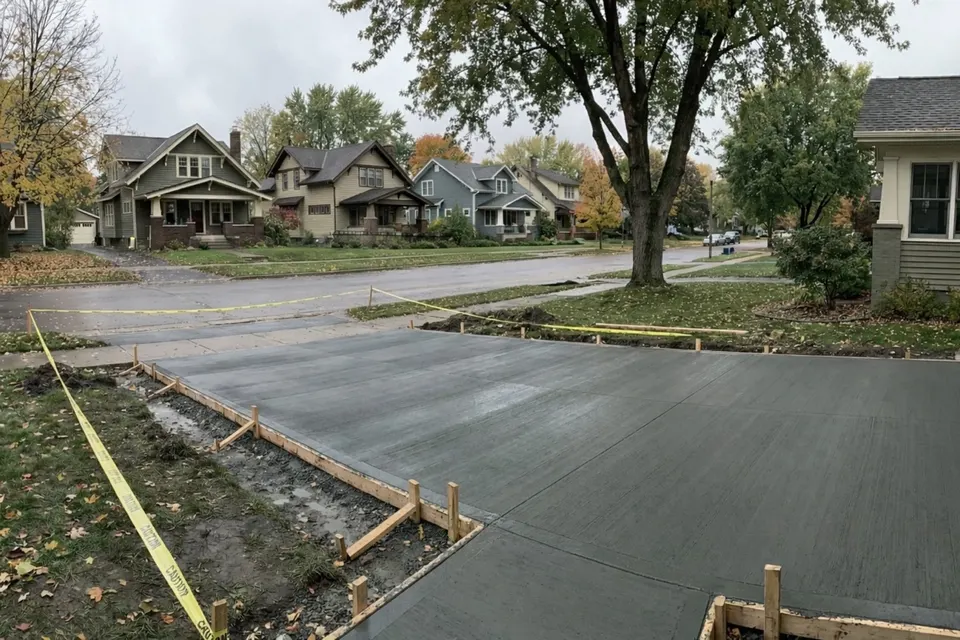
In short: A concrete driveway in central Minnesota is priced by square footage, tear-out, how much base the soil needs, slab thickness, reinforcement, finish, site access, and the time of year. Two driveways of the same size can land far apart because of what is under them and how far the truck has to travel. Twin Cities cost pages assume a short city driveway on existing base, which is not what most lots around Cokato look like.
We do not publish per-square-foot prices, and we will explain why at the end. What we can do is walk through exactly what moves the number on a driveway estimate in Wright, Meeker, and McLeod counties, so you can read a bid and know what you are looking at.
How much does a concrete driveway cost in Minnesota?
Every honest answer to this question is a list of factors, because concrete is priced per square foot only after everything else is known. The square footage sets the scale, and the rest of the list decides where in the range that footage lands. Here are the eight things we price on every driveway.
Square footage, and why bigger is cheaper per foot
The driveway’s area is the starting point, but the per-foot price is not flat. Setting up forms, ordering trucks, bringing the crew and equipment out, and finishing have fixed costs that get spread over the slab. A 400-square-foot pad and a 1,200-square-foot driveway do not cost three times apart. The bigger job is cheaper per foot.
This is the first place metro cost pages mislead rural buyers. They quote a per-foot figure based on a typical two-car city driveway of 500 to 700 square feet. A 12-foot-wide approach that runs 250 feet from a county road is 3,000 square feet, and its per-foot price is a different number.
Tear-out of the old driveway
If there is an existing slab, it has to be broken out, loaded, and hauled to a recycler. That is a day of labor and equipment on a typical two-car driveway, more on a thick old slab or one with rebar in it. Asphalt tear-out is faster than concrete.
Tear-out also reveals the second cost: what the old driveway was sitting on. Around Cokato we regularly find a couple inches of gravel over topsoil under a slab that has been cracking for years. That means the base has to be built new, which brings us to the biggest variable on the list.
Base depth: what the soil needs
The gravel base is where two driveways of identical size can separate the most. On solid glacial till, once the topsoil is stripped, 4 to 6 inches of compacted Class 5 aggregate is plenty. On the wet ground around Cokato Lake, the low ground along the South Fork Crow River in Hutchinson, or any spot where water sits in spring, we may need to excavate deeper, lay fabric, and bring in 8 to 12 inches of base to get a stable platform.
Every inch of base is excavation, trucking, and compaction. It is also the part of the job that decides whether the driveway is still flat in ten years. We do not shave the base to hit a price, and we are upfront when a lot needs more than the standard depth.
Thickness: 4 inches versus 5 to 6
A 4-inch slab is the code minimum for passenger cars. We recommend 5 inches for most driveways in this area and 6 inches for RV pads, farm approaches, and the first stretch off a county road where delivery trucks turn in. Our post on how thick a concrete driveway should be covers the reasoning.
On price, thickness is a smaller lever than people expect. Going from 4 to 5 inches adds about a quarter more concrete but almost no extra labor, since the forming, placing, and finishing take about the same time. It is one of the better values on the list.
Reinforcement
Rebar on a grid costs more than wire mesh in material and in the time to tie it. Fiber in the mix is cheaper than either but does a different job. We put rebar in 5- and 6-inch slabs as standard, because it holds position during the pour and does the most to keep cracks tight when the ground moves. Skipping reinforcement is a real savings on the bid and a real cost a few winters later.
Finish
A standard broom finish is the baseline. Exposed aggregate, colored concrete, stamped borders, or a full stamped surface each add material and finishing time, and stamped work needs sealer that has to be reapplied every couple of years. Most driveways in our area are broom finish with maybe a stamped or colored border at the garage. That is a sensible place to spend a little if you want the look without pricing the whole slab as decorative.
Site access and trucking
Where the trucks can go changes the labor. A driveway the ready-mix truck can back right up to is a straightforward pour. One behind a house, across a septic field, or up a soft approach may need a pump truck or a lot of wheelbarrow time. Both cost more.
Rural lots add plant distance. Concrete has a limited working time in the drum, and a long haul from the plant means we time pours tighter, sometimes with smaller loads. That is not a line item you see on a metro estimate, because in the metro the plant is ten minutes away.
Season
Spring is wet and busy. Summer and early fall are the most predictable conditions and the most efficient pours. Late fall through early winter is workable in Minnesota, but it requires accelerators in the mix, insulated blankets on the slab for several days, and more crew time managing the cure. We only add those costs when the forecast requires them, and we explain what you are paying for when we do.
Why Twin Cities price pages do not fit a rural lot
If you search driveway cost in Minnesota, every result is a Minneapolis or St. Paul contractor. Their numbers are real for their market, and they are built on a set of assumptions: a driveway of 500 to 800 square feet, a curb cut that already exists, existing base under an old slab, a ready-mix plant a few miles away, and a city lot with a hard surface for the truck to sit on.
Most driveways we pour in Cokato and out toward Hutchinson break all of those at once. The lot came off a farm field. The approach is 150 to 400 feet from a county highway, with an access permit and a culvert to size. The ground has never been prepared for concrete, and part of it is low. The concrete plant is a real drive away. The owner wants the apron and the pad at the house in concrete now and the run between them in gravel until next year.
A per-foot number built for a city driveway tells you almost nothing about that job. It can be too high on the per-foot basis, because the job is large, and too low overall, because the base and approach work are missing from it. The only way to price a rural driveway is to look at the site.
Why we do not publish prices
Concrete, gravel, fuel, and trucking prices move every season, and a number on a web page is wrong within months. More important, a published per-foot figure encourages comparing bids by the cheapest number rather than by what is in them. Two bids on the same driveway can be far apart because one includes 6 inches of compacted base, rebar, and a 5-inch slab and the other does not say. We would rather show you a written scope that lists every one of the eight factors above and let you compare that.
We give written estimates on concrete driveways throughout Wright, Meeker, and McLeod counties, and we walk the lot before we write the number. If you want to know where your driveway falls, send us the address and what you plan to park on it, and we will tell you what we expect to find.
Want us to look at your job?
Free written estimate after we walk the site. We tell you which permit office it falls under before you fill anything out.
Questions we get asked
How much does a concrete driveway cost in Minnesota?
It depends on eight things: square footage, whether an old driveway has to come out, how much gravel base the soil needs, slab thickness, reinforcement, finish, site access, and season. Price per square foot drops as the job gets bigger and rises with tear-out and deep base. A written estimate on your lot is the only reliable number.
Why is a rural driveway priced differently than one in town?
A rural driveway is usually much longer, often starts at a county highway with an access permit and culvert, and sits on ground that has never been prepared for concrete. Concrete trucks travel farther, so pours are timed around plant distance. Those factors change the price in ways that a metro per-square-foot number does not capture.
Does tear-out add a lot to the cost of a new driveway?
Yes. Breaking out an old slab, loading it, and hauling it to a recycler is real labor and trucking, and thick old slabs or ones with rebar take longer. What we find underneath also matters. If the old driveway was on black dirt, the base has to be built from scratch, which is the other cost the old slab was hiding.
Is a 5-inch driveway much more expensive than 4 inches?
The extra inch adds about a quarter more concrete but very little extra labor, since forming, placing, and finishing take about the same time. On most driveways it is a modest increase for a much stronger slab. Going to 6 inches for truck or RV loads is a similar step. Base prep and tear-out move the price more than thickness does.
Is it cheaper to pour a driveway in the fall?
Sometimes. Fall can have open schedule, but late-season pours in Minnesota need accelerators, insulated blankets, and more crew time on cure protection, which offsets any savings. Spring is busy and the ground is wet. Summer and early fall are the most predictable. We do not add cold-weather charges until the forecast actually requires the extra steps.