
MCM Concrete · September 8, 2026 · Concrete Driveways
How Thick Should a Concrete Driveway Be?
The short answer: A residential concrete driveway should be at least 4 inches thick for cars and light pickups, and 5 to 6 inches anywhere trucks, campers, or equipment will sit. In Wright County we recommend 5 inches for most driveways, poured over 4 to 6 inches of compacted Class 5 base, because frost movement in our glacial till does more damage to a thin slab than the vehicles ever will.
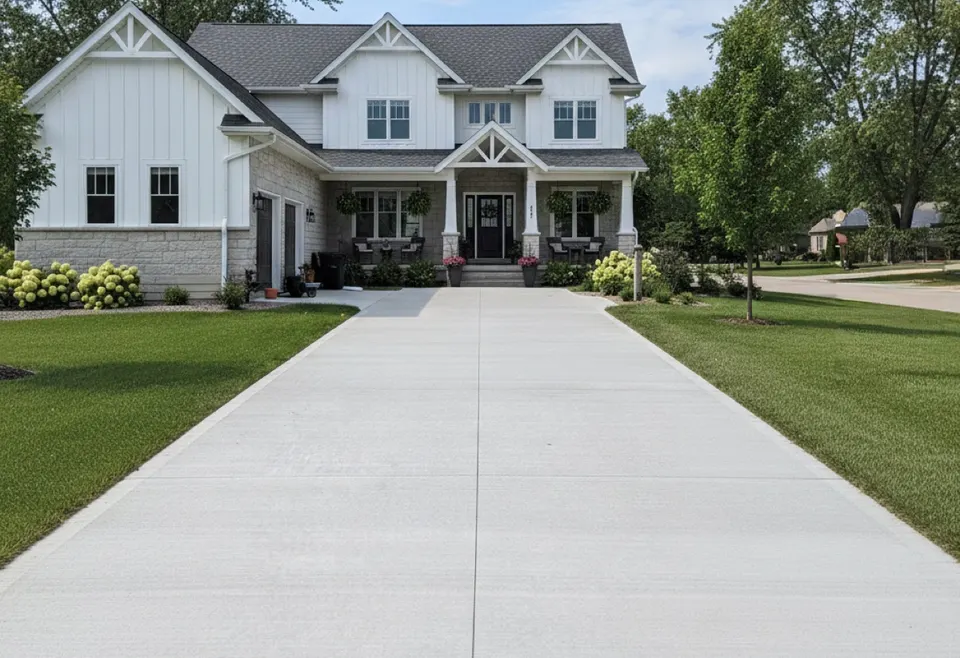
The short answer: A residential concrete driveway should be at least 4 inches thick for cars and light pickups, and 5 to 6 inches anywhere trucks, campers, or equipment will sit. In Wright County we recommend 5 inches for most driveways, poured over 4 to 6 inches of compacted Class 5 base, because frost movement in our glacial till does more damage to a thin slab than the vehicles ever will.
We get this question on most driveway estimates, and the honest answer depends on what will park on it and what the ground underneath is doing. Here is how we think about it on jobs in Cokato, Buffalo, and the rest of the US-12 corridor.
Four inches, five inches, or six
Four inches has been the residential standard for a long time, and it is still the code floor for a slab that carries passenger vehicles. On a two-car driveway in town that sees sedans, an SUV, and a half-ton pickup, a 4-inch slab on a good base will hold up.
Five inches is what we recommend for most driveways in Wright County. Concrete carries load by bending, and its bending strength goes up with the square of the thickness. Going from 4 to 5 inches adds about a quarter more concrete but roughly half again the load capacity. That margin is what keeps a slab from cracking when a soft spot develops under it in March or when a moving truck backs up to the garage.
Six inches belongs anywhere heavy vehicles are routine. That includes RV pads, the apron where a garbage truck swings in, farm approaches that see grain trucks and skid steers, and rural sites where propane and fuel delivery trucks come up the drive all winter. Six inches with rebar is also what we suggest for the first 20 to 30 feet off a county road, where the heaviest traffic turns in.
Why the base matters more than the slab
A driveway is only as good as what it sits on. A 6-inch slab on black dirt will fail before a 4-inch slab on a compacted base, and we have torn out plenty of thick driveways that proved it.
Most of Cokato and the surrounding townships sit on glacial till. Once the topsoil is stripped, it makes decent bearing soil. The exceptions are the low ground around Cokato Lake and the wet spots south of town, where the soil holds water and moves more when it freezes. The same pattern shows up across Wright County: higher ground drains and behaves, lake lowlands do not.
Our standard base is Class 5 aggregate, the crushed gravel spec Minnesota road builders use, placed 4 to 6 inches deep and compacted in lifts. On wet ground we go deeper and sometimes add a geotextile fabric under the gravel to keep it from working down into the clay. The point of the base is twofold: spread the load and give water somewhere to go. Water that stays under a slab turns to ice, and ice lifts concrete.
Frost heave and why driveways still move
Footings in Wright County go to 42 inches because that is the frost depth Minnesota code assigns to this part of the state under Minn. R. 1303.1600. A driveway does not get frost footings. It is a floating slab that rides on top of the frost, so the goal is not to stop movement but to make it uniform.
Uniform movement comes from three things: consistent base thickness, no soft pockets, and drainage that keeps the soil under the slab as dry as possible. We slope driveways about a quarter inch per foot away from the garage, and we make sure downspouts and sump discharge do not dump water along the edge of the slab. A driveway that gets wet on one side and stays dry on the other will heave unevenly, and that is where the diagonal cracks come from.
The garage apron deserves its own mention. It sits against a foundation that does not move, next to a slab that does, and it takes the most turning traffic. We isolate it from the foundation with an expansion joint, run the rebar through it, and often pour it an inch thicker than the rest of the drive.
Reinforcement, joints, and the mix
Thickness and base handle most of the structural work. Three details finish the job.
- Reinforcement. We tie #4 rebar on a grid in 5- and 6-inch slabs and set it at mid-depth on chairs. Wire mesh is acceptable in a 4-inch slab if it actually stays in the middle of the pour. Fiber in the mix helps control surface cracking but does not replace steel.
- Control joints. Concrete shrinks as it cures and it will crack somewhere. We saw-cut joints the morning after the pour, spaced at roughly 10 to 12 feet for a 5-inch slab and cut a quarter of the slab depth, so the cracks happen in straight lines where nobody sees them. Isolation joints separate the driveway from the garage apron and any sidewalk it meets.
- The mix. Exterior concrete in Minnesota should be an air-entrained mix in the 4,000 psi range, with 5 to 7 percent entrained air. The air voids give freezing water room to expand without breaking the surface. A non-air-entrained mix will scale within a few winters, especially once deicer hits it.
Our concrete driveway page covers finishes and the full process if you want the longer version.
Rural approaches on the US-12 corridor
A lot of our driveway work is not a 24-by-30 pad in town. It is a long approach from a county road to a house or shop on a lot split off farmland. Those jobs change the thickness conversation.
The approach at the road carries the most weight and takes the most abuse from plows and turning trucks, so we pour that section at 6 inches with rebar. A new driveway onto a county highway also needs an access permit from the Wright County Highway Department, and the county has its own construction specs for the apron and culvert. Up the drive, 5 inches is usually the right call. Some owners pour the apron and the pad at the house in concrete and leave the run between them in gravel until the budget allows, which is a reasonable way to phase the work.
What a driveway replacement looks like with us
Most of the driveway work we do in Cokato and Buffalo is replacement. The old slab has heaved, cracked, or started pushing against the garage apron, and the owner wants it done right this time.
We break out and haul away the old concrete, then look at what is underneath. Often the answer is a couple inches of gravel over topsoil, which explains the cracks. We strip to solid ground, bring in Class 5, compact it, and set forms to the new grade. Rebar goes in on chairs. The pour happens in one placement so there are no cold joints, the finish goes on, and we cut control joints the next morning. Then the slab cures for a week before cars and four weeks before anything heavy.
If you are planning a new driveway or replacing one that has given up, we are glad to look at the site and tell you what thickness and base make sense for your ground and your vehicles. Every lot is a little different, and the right answer is usually clear once we see it.
Want us to look at your job?
Free written estimate after we walk the site. We tell you which permit office it falls under before you fill anything out.
Questions we get asked
Is 4 inches thick enough for a concrete driveway in Minnesota?
Four inches works for a driveway that only carries cars and light pickups, as long as it sits on a compacted gravel base and has rebar or mesh. In Minnesota we recommend 5 inches for most driveways. The extra inch costs a little more concrete and buys a lot of tolerance for frost movement and the occasional heavy truck.
Should a concrete driveway have rebar or wire mesh?
We prefer rebar on a grid for 5- and 6-inch driveways, because it stays where we set it during the pour. Wire mesh works in a 4-inch slab if it is held at mid-depth on chairs. Fiber in the mix helps with surface cracking but is a supplement to steel, not a replacement for it.
How long before I can drive on a new concrete driveway?
Keep cars off for 7 days in warm weather and longer in cold weather. Hold heavy vehicles, campers, and delivery trucks off for 28 days, which is when the mix reaches its design strength. Foot traffic is fine after a day or two. A late-fall pour needs extra time because concrete cures slowly when it is cold.
How thick should the gravel base under a driveway be?
Plan on 4 to 6 inches of compacted Class 5 aggregate under a residential driveway on decent soil. Wet or soft ground needs more, sometimes 8 to 12 inches, after the topsoil comes out. The base carries the load and drains water away from the slab, so skimping here shows up as cracks within a few winters.
Does a thicker driveway stop frost heave?
No. Frost heave comes from water freezing in the soil under the slab, and thickness alone does not stop that. A thicker slab bridges soft spots better and cracks less when the ground moves, but the real fix is stripping topsoil, compacting a drained gravel base, and grading so water runs off instead of soaking in.